2025 is being heralded as the year of “Agentic AI”-the shift from chatbots that just talk to agents that actually do. But until now, most of what we knew about how people use these tools was based on small surveys or theoretical hype.
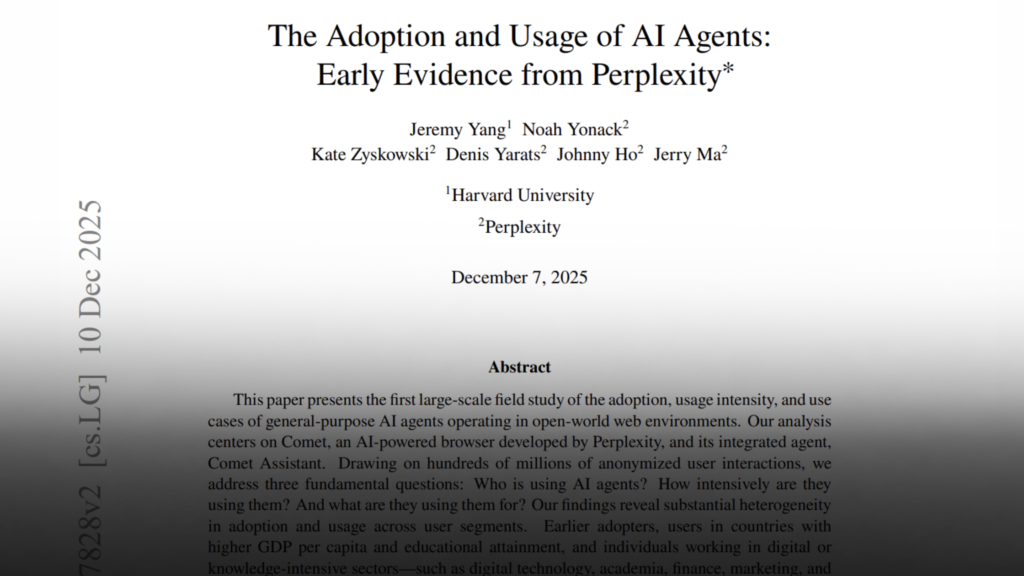
That changed this week: Researchers at Harvard University and Perplexity published a groundbreaking field study, “The Adoption and Usage of AI Agents: Early Evidence from Perplexity.” Drawing on hundreds of millions of anonymized interactions with Comet (Perplexity’s AI-powered browser) and its integrated Comet Assistant, this paper offers the first large-scale look at AI agents in the wild.
1. The “Who”: The Knowledge Worker’s New Best Friend
One of the clearest findings of this study is that, today, the majority of AI agent adoption rests with the “digital elite.” The researchers found substantial heterogeneity—meaning usage isn’t spread out uniformly across the population.
The Power Users: The adoption is highest among users in countries with higher GDP per capita and higher educational attainment.
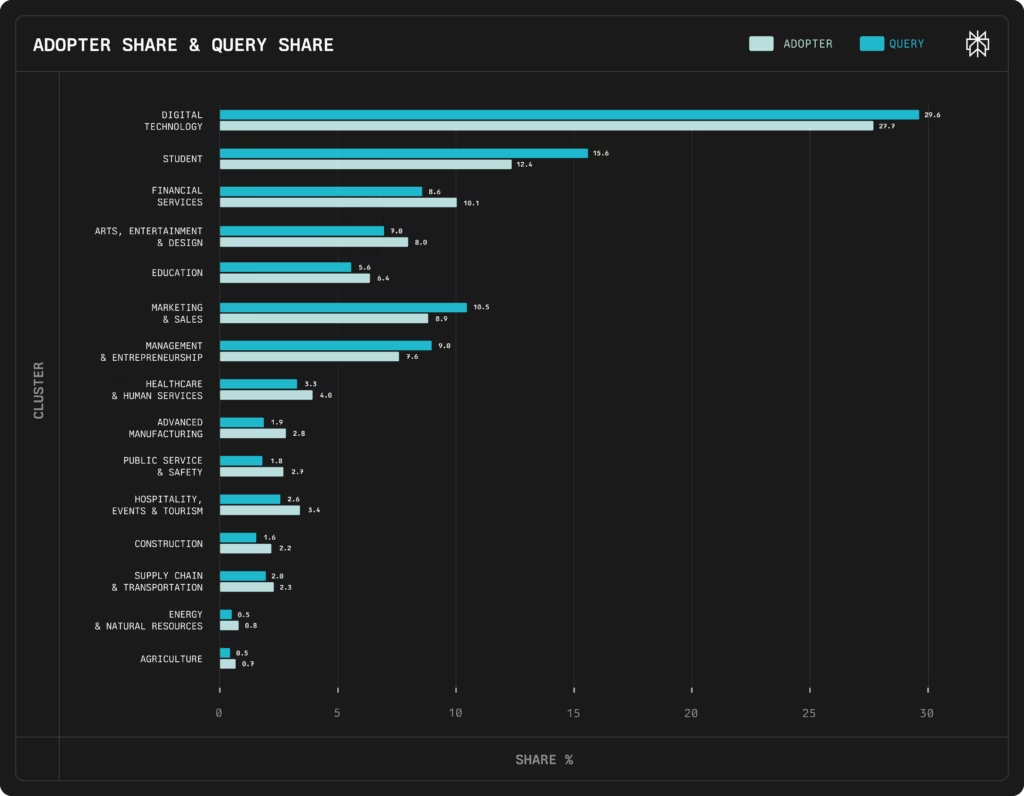
The Sectors: Not surprisingly, the Digital Technology sector leads the pack with 28 percent of all adopters and 30 percent of all agentic queries.
The Users: Besides technology, the most avid users are from knowledge-based industries, namely Academia, Finance, Marketing, and Entrepreneurship.
2. The “What”: Productivity Reigns Supreme
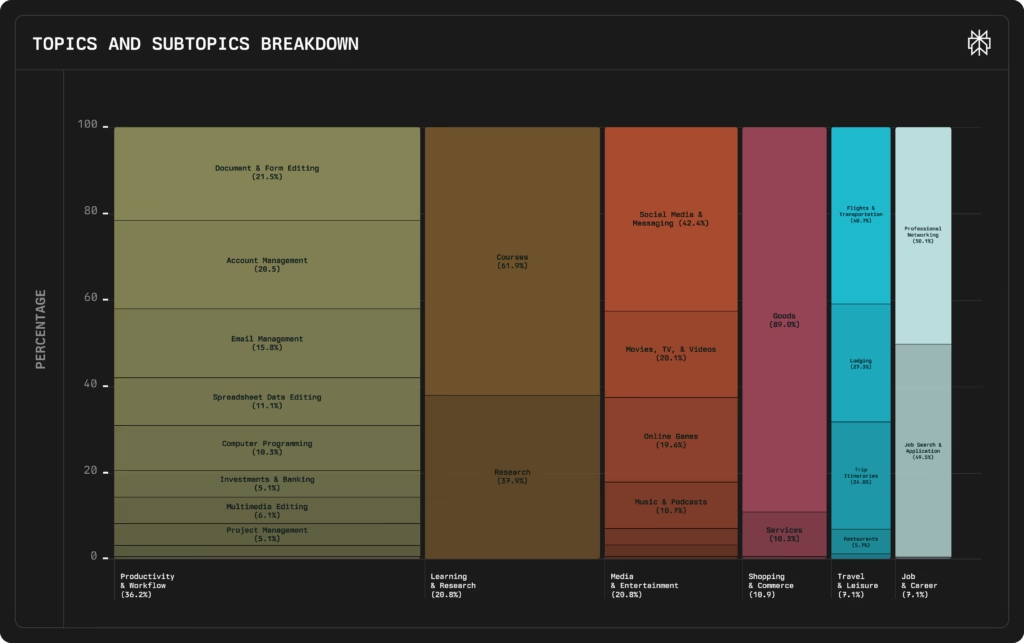
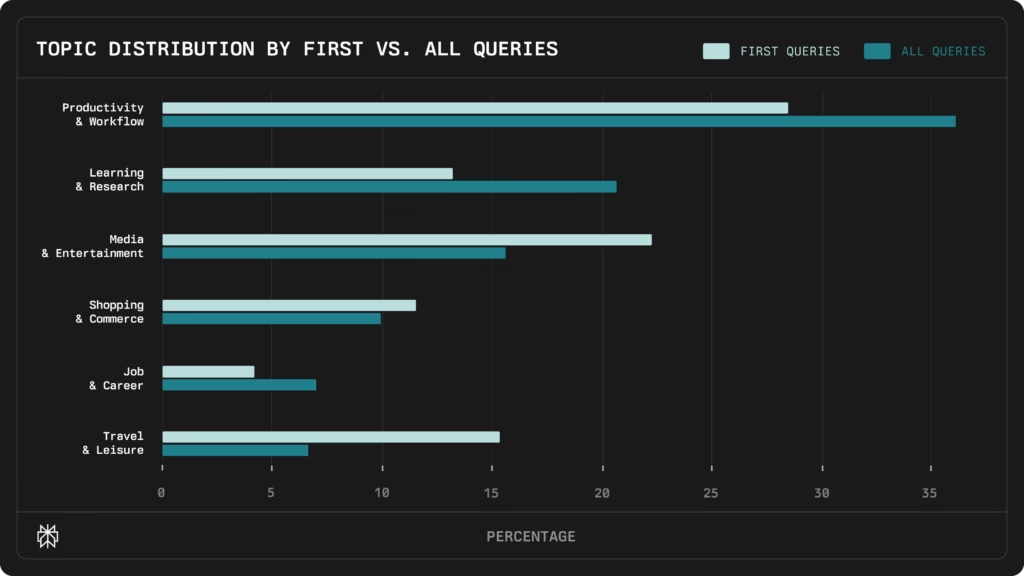
Contrary to the belief that people only use AI to plan vacations or shop, this data shows users are deploying agents for serious work. The researchers developed a “Hierarchical Agentic Taxonomy” to categorize user intent, and found that 57% of all agentic queries go to just two massive categories:
- Productivity & Workflow (36%)
- Learning & Research (21%)
Shopping & Commerce comes in third at 10%, followed by Media & Entertainment at 16%.
Top Sub-Topics: When you drill down deeper, the specific use cases become even clearer. Specific usage cases are dominated by Courses at 13%, Shopping for Goods at 9%, and Document Editing at 8%.
Top Tasks: Out of 90 possible task types identified, the top 10 account for over half—55% of all activity. The most frequent single task? Exercise assistance, at 9%, followed by research summarization and document creation.
3. The “Where”: Personal versus Professional
While productivity is the top topic, the context of usage is surprisingly blended.
- Personal Use: 55% of queries.
- Professional Use: 30% of queries.
- Educational Use: 16% of queries.
The “Super-App” Effect: The study also analyzed the “environments”—the websites where agents perform tasks. The concentration is intense. For professional networking, LinkedIn accounts for 93% of queries. For video tasks, YouTube dominates. On the other hand, shopping is more fragmented across different sites.
4. “The Shift”: From Novelty to Utility
One of the most intriguing observations presented in this paper is how user behavior develops over time. In the short run, use is “sticky”—once you begin using an agent to code, you continue to use the agent to code. But over time, as users become more comfortable with the technology, their behavior changes.
The pattern in the data indicates that the users migrate away from simpler topics, such as “Travel” and “Media”, to more cognitively demanding topics like Productivity, Learning, and Career.
The Takeaway: Users might come for the novelty—e.g., “Find me a movie to watch”—but they stay for the utility, such as “Analyze this spreadsheet” or “Debug this code”.
5. The Intensity Gap
Not all users are created equal. The study identifies two groups: the “General Availability” (GA) crowd, and the “Early Adopters”—those who had access before the public launch.
The difference is staggering: An average Early Adopter makes 9x more agentic queries than an average user who joined during the public launch. This suggests that once users cross a certain threshold of trust and capability, the agent becomes deeply integrated into their daily workflow.
Conclusion: The Future Is Automated
This paper represents the first hard evidence that AI agents are making their transition from “cool demo” to “essential tool.” They are not just being used to browse the web; they are being used to edit documents, manage accounts, summarize research, and write code.
As the researchers point out, the diffusion of these capable agents has huge implications for businesses and policymakers. In case adoption stays concentrated in high GDP, high education sectors, we face the risk of a productivity divide. But if these tools become accessible to everyone, they represent one of the most significant shifts in how we interact with the digital world.
Source: Yang, J., Yonack, N., et al. (2025). “The Adoption and Usage of AI Agents: Early Evidence from Perplexity.” arXiv:2512.07828v2.
https://arxiv.org/abs/2512.07828